Pantheism vs Gnosticism
One says matter is the mistake. The other says matter is the miracle. Both were called heresy.
Gnosticism and pantheism have almost nothing in common except a shared enemy and a shared fate. Both were condemned by orthodox Christianity. Both offered an alternative to the God of the churches. And both have been rediscovered by modern seekers looking for something older and stranger than Sunday school. That is where the resemblance ends.
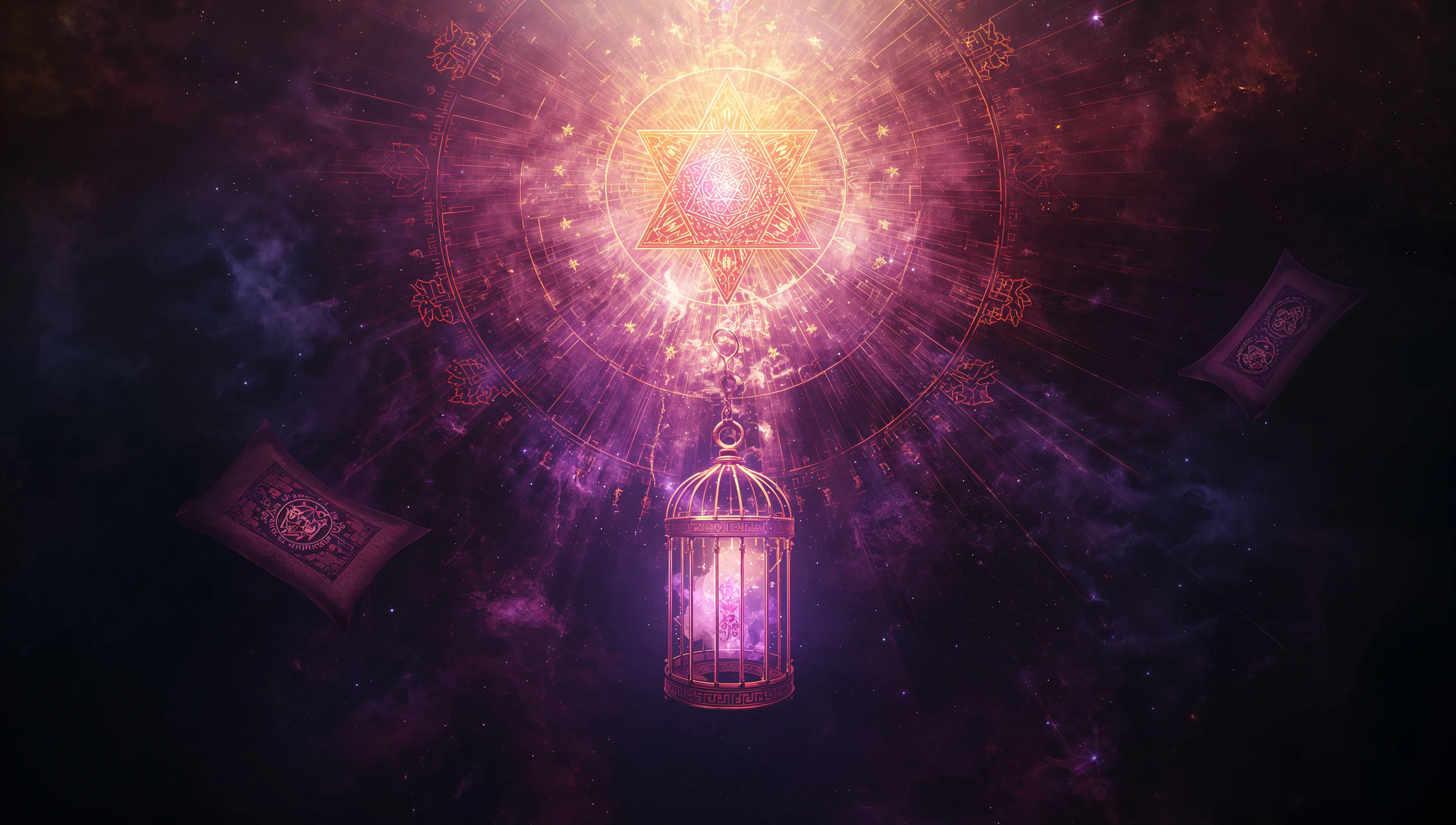
The Gnostics, a cluster of movements from the first few centuries CE, taught that the material world is a botched creation. A lesser, ignorant god, the Demiurge, made it, and trapped divine sparks, our true selves, inside bodies and matter. Salvation is gnosis: secret knowledge that wakes the spark and lets it escape back to the true God, who is utterly beyond this world. The cosmos, in this picture, is a cage.
Pantheism is the exact inversion. There is no true God beyond the world because there is no beyond. The material universe is not a mistake made by a lesser being; it is the divine itself, the only sacred thing there is. Nothing is trapped. Nothing needs escaping. The body you are reading this in is not a prison for a spark; it is a piece of the universe that learned to read.
What they share
- ✓Both rejected the orthodox Christian picture of God and were condemned for it
- ✓Both take the problem of suffering seriously rather than explaining it away
- ✓Both prize direct experience or knowledge over inherited belief
- ✓Both were marginal, persecuted or suppressed for long periods
- ✓Both have been revived by modern people dissatisfied with mainstream religion
- ✓Both refuse a God who is simply a bigger, kinder version of a king
Where they part ways
Is the material world good?
This is the whole argument. Gnosticism: no. Matter is the work of an ignorant or malicious creator; the world is darkness, ignorance, a trap. Pantheism: yes, without qualification. Matter is the divine substance. Stars, soil, bodies, the works. To a pantheist, the Gnostic contempt for matter is the one truly unforgivable error, because it despises the only sacred thing.
Where is God?
The Gnostic true God is radically transcendent: beyond the cosmos, unknowable, untouched by the mess of creation, reachable only by the spark within. The pantheist God is radically immanent: the cosmos itself, knowable through every sense you have, reachable by walking outside. Gnosticism puts God at an infinite distance. Pantheism removes the distance entirely.
What is a human?
In Gnosticism, a divine spark imprisoned in a body it does not belong to; the body is foreign, even hostile. In pantheism, a body that is entirely of this world, a temporary pattern the universe is making. There is no spark from elsewhere because there is no elsewhere. You belong here the way a wave belongs to the sea.
Salvation or belonging
Gnosticism offers escape: wake up, remember your origin, leave. Pantheism offers the opposite: wake up, notice where you are, stay. The Gnostic wants out of the cycle of matter. The pantheist cannot imagine anywhere better to be and finds the desire to leave faintly tragic.
Secret or open
Gnosis was secret knowledge, passed to initiates, hidden from the ignorant many. Pantheism has no secrets. Everything it claims is on view: the sky, the tree, the fact that you are here. There is nothing to reveal because nothing is hidden. The only work is paying attention.
Side by side
| Question | Pantheism | Gnosticism |
|---|---|---|
| The material world | The divine itself; wholly good as the sacred whole | A flawed or evil creation; a prison |
| Creator | None; nature was not made | The Demiurge, a lesser and ignorant god |
| True God | The universe | Utterly beyond the universe |
| The human self | A pattern within nature | A divine spark trapped in matter |
| Goal | Belonging; reverence; presence | Escape from matter through secret knowledge |
| The body | Sacred, as part of the whole | A cage, foreign to the true self |
| Knowledge | Open to anyone who looks | Secret, initiatory |
Two answers to the same wound
It would be easy to treat Gnosticism as pantheism's photographic negative and leave it there. But both traditions began from the same observation, and it is worth honouring: the world hurts. Children die. Cruelty succeeds. The body fails. Any serious worldview has to say something about this, and the orthodox answer, that a good and all-powerful God made it this way for reasons, has never satisfied everyone.
The Gnostics solved the problem by splitting God in two. The good God did not make this; a lesser one did. That preserves divine goodness at the cost of the world. If the cosmos is a botched job by an inferior craftsman, its cruelty is no longer a theological scandal; it is just what you would expect. The price is that you have to hate the place you live in, and treat your own body as the enemy. Many Gnostics paid it willingly. Their writings can be beautiful and are often desperately sad.
Pantheism solves the problem by refusing the premise. The universe is not the work of a good God, so its cruelty is not a betrayal by one. It is not the work of a bad God either. It is simply the whole, unfolding by its own nature, indifferent to individual outcomes and yet, taken entire, the most astonishing thing that could exist. The earthquake and the child are both real, both nature, both sacred as parts of the one thing. This does not make the earthquake good. It makes it not a punishment, not a mistake, and not evidence that you should want to leave.
Modern people who feel the world is wrong sometimes find themselves drawn to Gnostic ideas without knowing the name: the sense that we are exiles, that reality is a simulation, that the true self is elsewhere. Pantheism is the argument against all of that. You are not an exile. This is not a simulation. The true self is exactly here, made of exactly this. If the world seems like a prison, the pantheist reply is: look again at the walls. They are made of stars.
Which one sounds like you?
Gnosticism fits if your deepest intuition is that you do not belong here, that the material world is fundamentally wrong, and that the truth about yourself is hidden and elsewhere. It is a serious and ancient response to that intuition, and it has consoled people for two thousand years.
Pantheism fits if your deepest intuition, even on bad days, is that you do belong here, that the material world is the most remarkable thing you have ever encountered, and that whatever is true about you is written in the same language as the trees. If the Gnostic contempt for the body and the earth strikes you as a kind of ingratitude, you are already on this side.
Questions people ask
What is the difference between Gnosticism and pantheism? +
Gnosticism teaches that the material world was made by a lesser, flawed god and that the true self is a divine spark trapped in matter, seeking escape through secret knowledge. Pantheism teaches that the material universe itself is the divine, nothing was created by anyone, and the goal is belonging to the world rather than escaping it. They are near-opposites.
Do Gnostics believe the world is evil? +
Broadly, yes. Most Gnostic texts describe the material cosmos as the flawed or malicious creation of the Demiurge, a place of ignorance and darkness in which divine sparks are imprisoned. Some Gnostic schools were less hostile to matter than others, but contempt for the physical world is a defining feature of the movement.
Is pantheism a form of Gnosticism? +
No. They share only a rejection of orthodox theism. Gnosticism is dualist: a true God beyond the world and a flawed world below. Pantheism is monist: one reality, the universe, which is the divine. Gnosticism despises matter; pantheism reveres it. Calling one a form of the other misreads both.
Is simulation theory a modern Gnosticism? +
It has been called that, with some justice. Both hold that the everyday world is not the real one, that we are inside something made by a lesser maker, and that the truth lies outside. Pantheism rejects both for the same reason: there is no outside. The world you are in is the only one, and it is not a copy of anything.