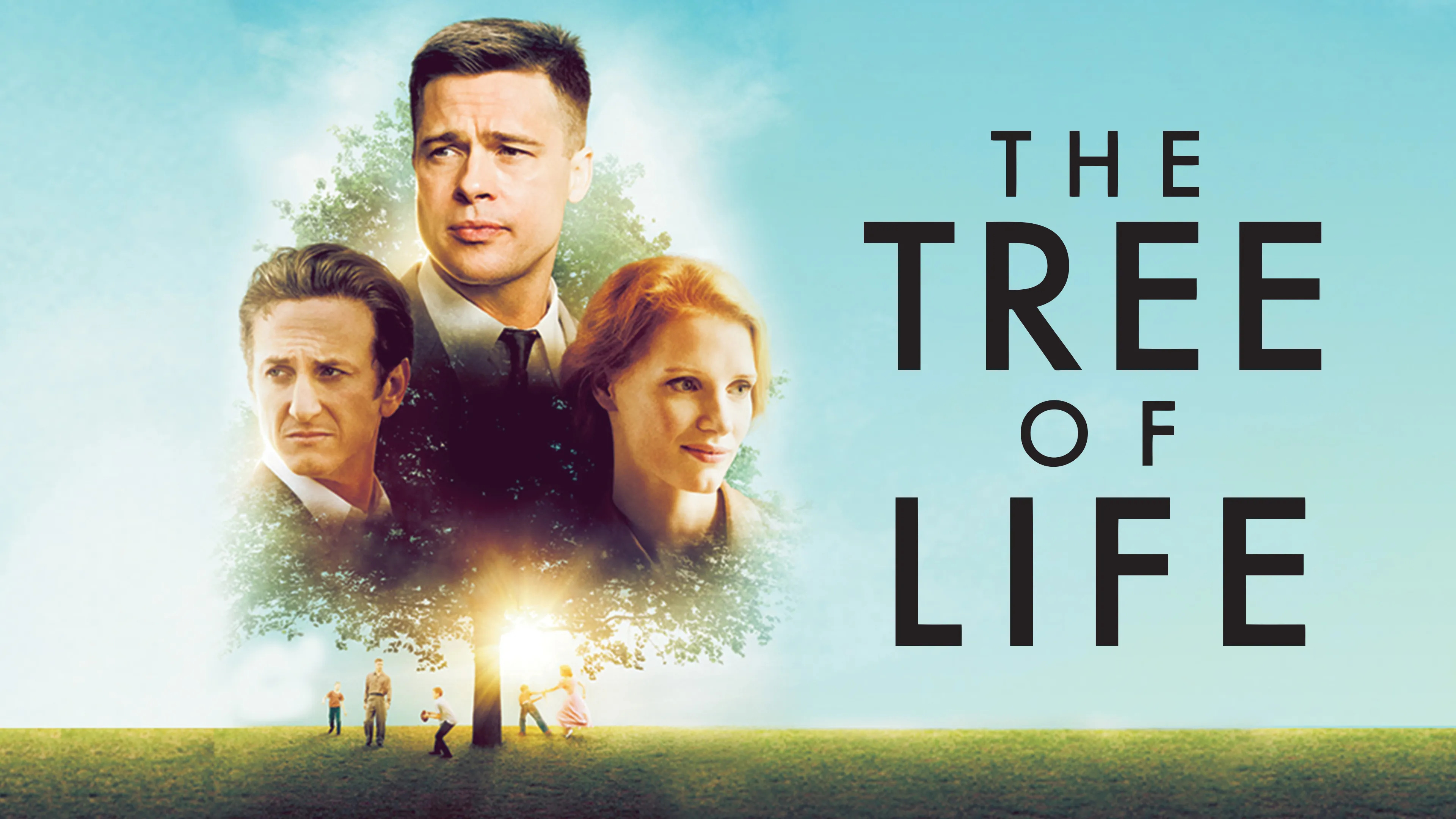

A family in 1950s Texas. The birth of the universe. Dinosaurs. A mother's grief. The death of a son. Terrence Malick's The Tree of Life weaves these together into something that's less a film than a meditation - a visual prayer asking the oldest questions about existence, suffering, and what it means to be alive.
The film won the Palme d'Or at Cannes and divided audiences completely. Some found it pretentious and incomprehensible. Others found it the most profound cinematic experience of their lives. For pantheists, it's something rare: a major film that takes cosmic spirituality seriously and arrives at conclusions remarkably close to our own.
The Central Question
The film opens with a whispered voice-over from the mother (Jessica Chastain):
"The nuns taught us there were two ways through life - the way of nature and the way of grace. You have to choose which one you'll follow."
Nature, in this framing, is self-assertion. It "only wants to please itself, gets others to please it too, likes to lord it over them." It's survival, competition, the struggle for dominance.
Grace is different. It "doesn't try to please itself. Accepts being slighted, forgotten, disliked. Accepts insults and injuries."
The film seems to set these up as opposites - and then spends two hours dissolving the distinction.
The Creation Sequence
About thirty minutes in, after establishing the family's grief over a son's death, the film does something extraordinary. It shows the creation of the universe.
The Big Bang. Galaxies forming. Stars igniting. The young Earth, molten and violent. The first stirrings of life. Cells dividing. Fish. Amphibians. Dinosaurs. All set to Lacrimosa from Zbigniew Preisner's Requiem and other sacred music.
This sequence lasts nearly twenty minutes. It's not narrative. It's not explained. It simply shows the universe unfolding across billions of years, leading eventually to a hospital in Waco, Texas, where a child is born.
The message is clear: this family's story is part of the cosmic story. Their grief is not separate from the universe - it's an expression of it. The same forces that formed galaxies formed them.
This is pantheism visualized. We're not observers of the cosmos - we're participants in it. Our lives, however small they seem, are continuous with the entire history of existence.
The Dinosaur Scene
In one brief, enigmatic scene, a predator dinosaur encounters a wounded herbivore. It places its foot on the creature's head - and then, inexplicably, walks away. It spares the prey.
What is Malick saying? Perhaps that grace isn't only human. Perhaps that even in the brutal world of nature, something like mercy can emerge. Perhaps that the distinction between nature and grace was always false.
For pantheists, this resonates. We don't see nature as fallen or corrupt, separate from the sacred. Nature IS the sacred. And within nature, compassion evolved. Cooperation evolved. Love evolved. These aren't supernatural additions to a brutal world - they're natural developments within it.
The Father and Mother
The film's human drama centers on the O'Brien family. The father (Brad Pitt) represents "nature" - strict, demanding, frustrated by his failed dreams of being a musician, sometimes cruel. The mother represents "grace" - gentle, loving, almost saint-like in her patience.
But Malick complicates this. The father isn't a villain. He loves his sons. He's trying to prepare them for a hard world. His harshness comes from fear and disappointment, not malice. And the mother's grace, while beautiful, sometimes seems passive, unable to protect her children from their father's anger.
Neither way is complete on its own. Pure nature without grace becomes cruelty. Pure grace without nature becomes weakness. The film suggests we need both - or rather, that we need to find where they're actually the same thing.
Jack's Struggle
The oldest son, Jack (Hunter McCracken as a child, Sean Penn as an adult), is caught between his parents' ways. He loves his gentle mother but resents her inability to stand up to his father. He fears his father but also wants his approval.
As a child, Jack does cruel things - kills a frog, breaks into a neighbor's house, treats his brother badly. He's testing the boundaries of nature, seeing what he can get away with. And he's wracked with guilt about it.
As an adult, Jack is successful but empty. He wanders through glass skyscrapers, disconnected from everything, still asking "Where are you?" - to his dead brother, to God, to meaning itself.
Jack's journey is the journey many of us take. We start with the simple categories we're taught - good and evil, nature and grace - and then life complicates them. We do things we're ashamed of. We lose people we love. We search for meaning in a world that doesn't offer easy answers.
Loss and Meaning
The film is structured around loss. We learn early that one of the three sons died at nineteen - killed in Vietnam, we eventually understand. The mother's grief is devastating. She asks God directly: "Where were you?"
This is the problem of evil, the question that has haunted religious thought forever. If God is good, why do children die? If the universe is meaningful, why is there such suffering?
Malick doesn't answer this question. He can't - no one can. But he reframes it. By placing the family's grief within the context of cosmic history, he suggests that suffering isn't a bug in the system. It's part of the system. The same processes that created life also created death. The same universe that produced love also produced loss.
This isn't comforting in the traditional religious sense. There's no promise that suffering has a purpose or that the dead are in a better place. But there's something else: the recognition that we're part of something vast, that our grief connects us to the deepest patterns of existence.
The Beach Sequence
The film ends with a mysterious sequence on a beach. The living and the dead mingle. Jack sees his younger self, his brothers, his parents at different ages. There are doorways standing in the sand. People embrace, forgive, let go.
Is this heaven? The afterlife? A dream? Malick doesn't say. It's more like a vision of reconciliation - a moment outside time where all the broken relationships are healed, where grace finally encompasses everything.
Some viewers find this sequence too religious, too hopeful. But it can also be read as psychological - as Jack finally making peace with his past, integrating the different parts of himself, accepting both nature and grace as part of who he is.
For pantheists, the sequence suggests something important: that meaning isn't found by escaping the world but by embracing it fully. The beach isn't somewhere else - it's here, seen differently. Heaven isn't a place you go - it's a way of seeing what already is.
Grace in Nature
The film's deepest insight is that grace and nature aren't opposites. They're aspects of the same reality.
The mother whispers: "Love every leaf, every ray of light." This isn't nature worship as an alternative to grace - it's the recognition that grace is found IN nature. The sacred isn't somewhere else. It's here, in leaves and light, in the ordinary stuff of existence.
As one reviewer wrote: "We don't need to choose between grace and nature. There is a third way, a middle way, where we find grace in nature... After all, here we are, the creations of eons of cosmic history, able to invent the concept of grace and to be inspired to live by it."
This is pantheism. The universe isn't divided into sacred and profane, spiritual and material, grace and nature. It's all one thing, and that one thing is worthy of reverence.
Malick's Vision
Terrence Malick is notoriously private and rarely explains his films. But his body of work suggests a consistent vision: humans as part of nature, the sacred present in the ordinary, meaning found through attention and presence rather than doctrine or belief.
The Tree of Life is his most explicit statement of this vision. It's a film that asks you to see your own life as part of the cosmic story - not metaphorically, but literally. The atoms in your body were forged in stars. The patterns that make up your consciousness emerged from billions of years of evolution. You are the universe, aware of itself.
This is what pantheism says. And Malick shows it more beautifully than any philosophical argument could.
How to Watch It
The Tree of Life isn't a film you watch for plot. There's barely any dialogue. The narrative jumps around in time. Long sequences have no obvious purpose.
It's a film you experience. You let the images wash over you. You sit with the questions it raises without demanding answers. You let yourself feel small against the cosmos and significant within it.
This is also how pantheists approach existence. Not grasping for certainty, but sitting with mystery. Not demanding that the universe make sense on human terms, but opening to what it actually is.
Why This Film Matters
In a culture that separates sacred from secular, spirit from matter, meaning from science, The Tree of Life insists on unity. It shows the Big Bang and a mother's grief as part of the same story. It finds the sacred in a suburban Texas street.
For pantheists, this is what we've been saying all along. The universe isn't divided. The sacred isn't elsewhere. Grace isn't opposed to nature - it emerges from it, as naturally as stars form from gas clouds or love evolves from chemistry.
The Tree of Life doesn't argue for this view. It shows it. And sometimes showing is more powerful than any argument.
Watch The Tree of Life when you're ready to sit with big questions without needing answers. When you want to feel your life as part of something vast. When you're grieving and need to know that grief, too, is part of the story.
It's not an easy film. But for those willing to meet it on its own terms, it offers something rare: a vision of existence where grace and nature are finally, beautifully, one.