
You don't need a telescope. You don't need to know the constellations. You don't need to be in a dark sky preserve (though it helps). All you need is a clear night, a few minutes, and the willingness to really look.
For pantheists, stargazing isn't just astronomy appreciation - it's a direct encounter with the sacred. Those points of light are nuclear furnaces billions of years old, and the atoms in your body came from stars just like them. When you look up, you're looking at your cosmic family tree.
Why Stargazing Matters
In our artificially lit world, most people rarely see the stars. We've lost something ancient - the nightly reminder that we're part of something vast. Our ancestors oriented their lives by the stars. They told stories about them. They felt small and connected at the same time.
When you stargaze with intention, you're reclaiming that connection. You're stepping outside the human bubble and remembering what you actually are: a conscious arrangement of matter on a small planet orbiting one of 200 billion stars in one of 200 billion galaxies.
The Practice
1. Find Your Spot
Ideally, get away from city lights. But even in a city, you can see the brightest stars and planets. A backyard, a park, a rooftop - anywhere you can see sky works.
2. Give Your Eyes Time
It takes about 20-30 minutes for your eyes to fully adapt to darkness. Resist the urge to check your phone - the light will reset your night vision. Just sit with the darkness.
3. Start with What You See
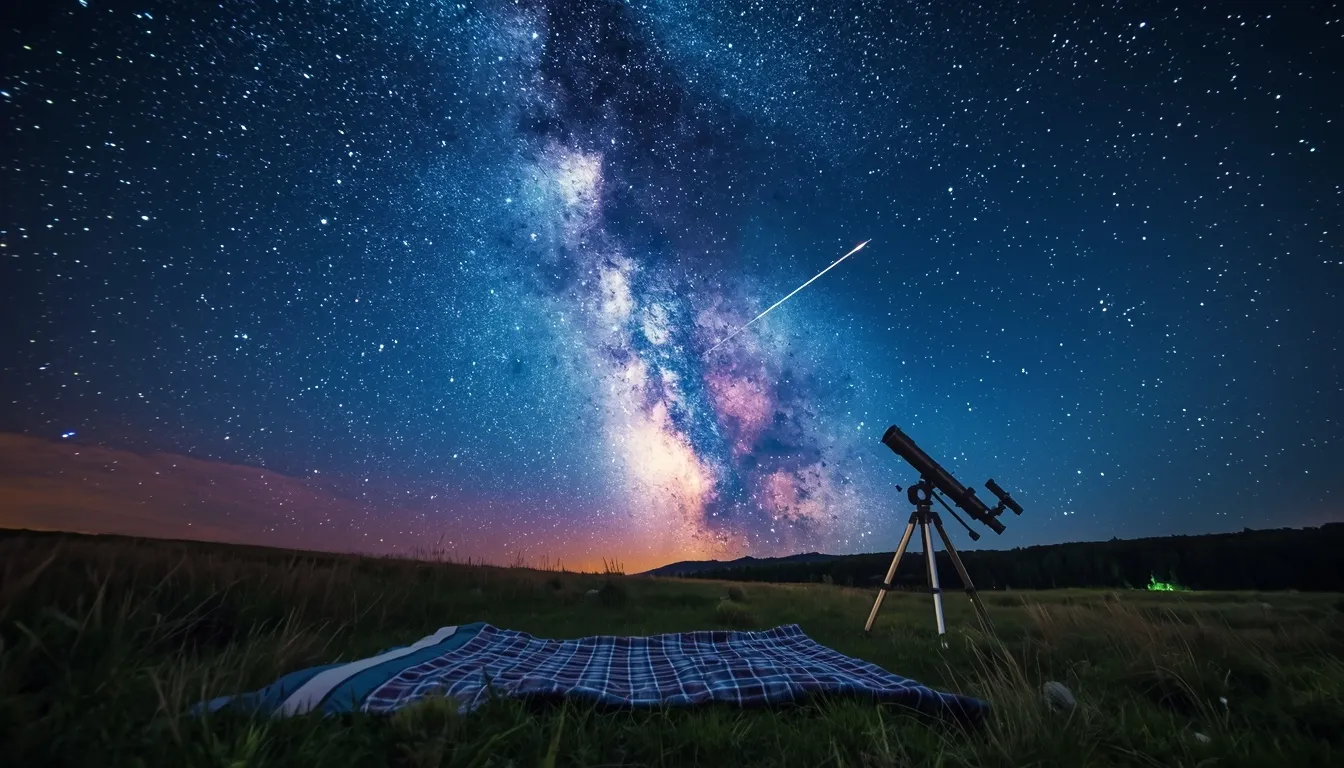
Don't worry about identifying constellations (unless you enjoy that). Just look. Notice the brightest stars. Notice the fainter ones that appear as your eyes adapt. If you're in a dark location, watch the Milky Way emerge - that's the edge-on view of our own galaxy.
4. Contemplate the Distances
Here's where it gets profound. That light you're seeing left those stars years, decades, centuries, or millennia ago. The light from Polaris (the North Star) left 430 years ago - around the time Shakespeare was writing plays. The light from the Andromeda Galaxy left 2.5 million years ago, before humans existed.
You're not just looking at space - you're looking at time.
5. Remember Your Connection
The carbon in your body was forged in the cores of stars that exploded billions of years ago. The iron in your blood, the calcium in your bones, the oxygen you're breathing - all of it was cooked up in stellar furnaces and scattered across the cosmos.
You're not looking at something separate from yourself. You're looking at your origins. You're looking at what you're made of.
Contemplations for Stargazing
As you gaze, let these thoughts settle in:
- Scale: Each of those points of light is a sun. Many have planets. Some of those planets may have life looking back at us right now.
- Time: The universe is 13.8 billion years old. Human civilization is about 10,000 years old. You're witnessing a tiny slice of an unimaginably long story.
- Connection: Every atom heavier than hydrogen was made in a star. You are literally made of star stuff, looking back at stars.
- Presence: Right now, in this moment, you are the universe experiencing itself. Consciousness looking at the cosmos that created it.
When to Practice
Some especially powerful times for stargazing:
- New moon nights - Darkest skies, most stars visible
- Meteor showers - Perseids (August), Geminids (December), Leonids (November)
- Planetary alignments - When planets are visible, you're seeing our solar system neighbors
- After significant life events - Births, deaths, transitions. The stars provide perspective.
No Equipment Needed
Binoculars can enhance the experience - you'll see craters on the Moon, Jupiter's moons, star clusters. But they're not required. The naked-eye experience is profound enough.
What matters isn't optical power. It's attention. It's presence. It's the willingness to feel small and connected at the same time.
The Takeaway
Stargazing as spiritual practice isn't about learning astronomy (though that's wonderful too). It's about regularly stepping outside the human-scale world and remembering the cosmic context of your existence.
You are not separate from those stars. You are made of the same stuff, following the same physical laws, part of the same unfolding story. When you look up, you're not looking at something "out there" - you're looking at home.
"The cosmos is within us. We are made of star-stuff. We are a way for the universe to know itself."
- Carl Sagan
Tonight, if the sky is clear, go outside. Look up. Stay for a while. Let the scale of it sink in. This is pantheist practice at its most direct - no books, no rituals, no intermediaries. Just you and the universe you're part of.