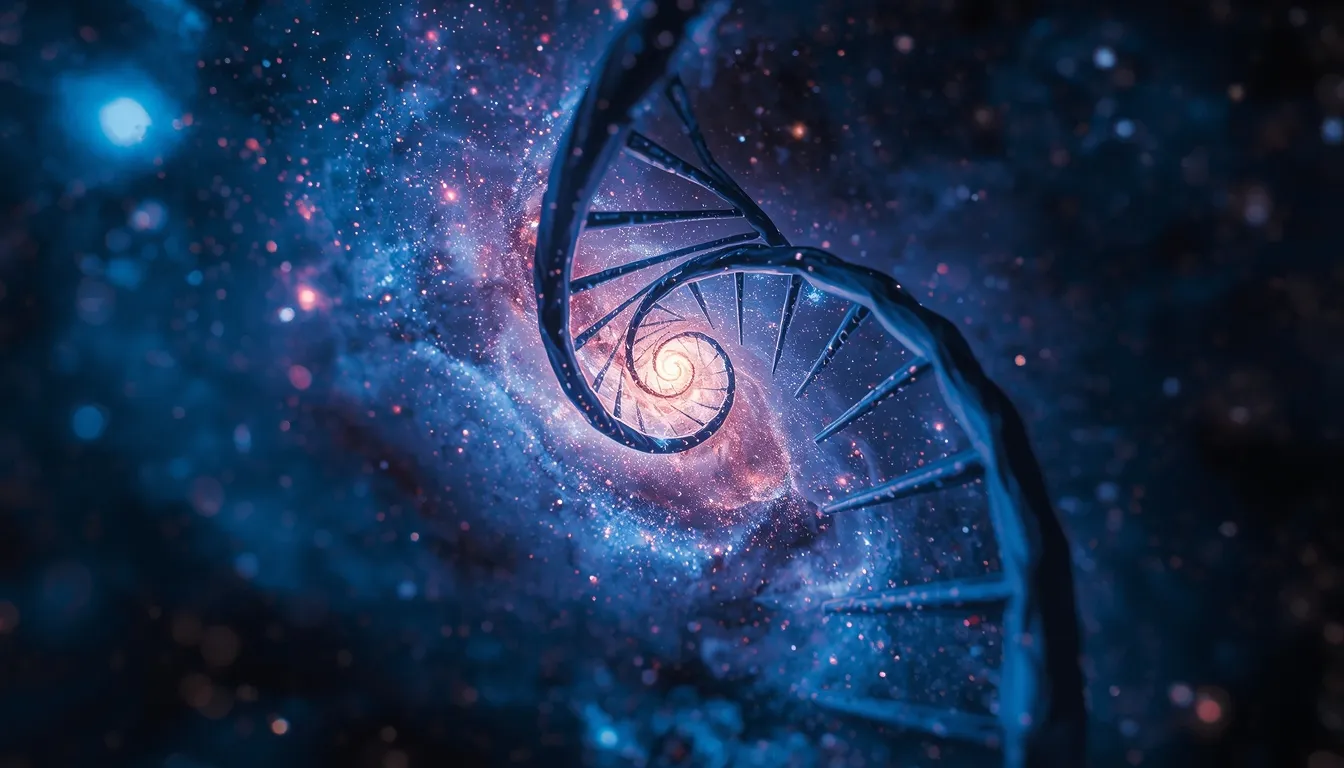

One of the most common questions about pantheism is whether it conflicts with scientific understanding. The short answer is no - in fact, many argue that pantheism is uniquely compatible with science. Here's why.
No Supernatural Claims
Traditional theism often requires belief in supernatural events: miracles, divine intervention, souls that exist outside physical reality. These claims can conflict with scientific methodology, which studies the natural world through observation and evidence.
Pantheism makes no such claims. It doesn't posit a God who intervenes in natural processes or exists outside the universe. Instead, it identifies the divine with the natural universe itself. There's nothing for science to disprove because pantheism isn't claiming anything beyond what science studies.
Science as Revelation
For pantheists, scientific discovery is a form of spiritual revelation. When astronomers map distant galaxies, when biologists uncover the mechanisms of life, when physicists probe the nature of matter - they are revealing the nature of what pantheists consider divine.
Einstein, who held pantheist views, saw his scientific work as deeply spiritual. He spoke of "cosmic religious feeling" - the sense of awe and wonder that comes from contemplating the rational order of the universe. For him, physics was a way of reading the mind of God.
"I want to know God's thoughts. The rest are mere details." - Albert Einstein
What Modern Science Reveals
Several areas of modern science resonate particularly well with pantheist intuitions:
Cosmology
We now know that the universe is approximately 13.8 billion years old, contains hundreds of billions of galaxies, and operates according to elegant mathematical laws. The sheer scale and order of the cosmos inspires the kind of awe that pantheists consider sacred.
We also know that we are literally made of stardust - the atoms in our bodies were forged in the hearts of ancient stars. This isn't poetry; it's physics. We are the universe experiencing itself.
Ecology
Modern ecology reveals the profound interconnectedness of all life. Ecosystems function as integrated wholes where every species plays a role. The pantheist intuition that "everything is connected" turns out to be scientifically accurate.
From the bacteria in our gut to the fungi networks connecting forest trees, life on Earth forms a complex web of relationships. We are not separate from nature - we are embedded in it.
Quantum Physics
While we should be cautious about over-interpreting quantum mechanics, some of its findings challenge our intuitive sense of separate, independent objects. Quantum entanglement, for instance, shows that particles can be correlated across vast distances in ways that defy classical physics.
This doesn't "prove" pantheism, but it does suggest that reality is more interconnected and mysterious than our everyday experience suggests - something pantheists have long intuited.
Neuroscience
Neuroscience shows that consciousness emerges from physical processes in the brain. Rather than diminishing the wonder of consciousness, this deepens it: the universe has organized matter in such a way that it can become aware of itself.
For pantheists, this is profound. We are not souls temporarily inhabiting bodies - we are the cosmos waking up, the universe developing eyes to see itself and minds to contemplate its own existence.
The Limits of Science
Science is extraordinarily powerful at explaining how things work. It can tell us how stars form, how evolution operates, how consciousness arises from neurons. But it doesn't tell us how to feel about these facts or what meaning to derive from them.
Pantheism fills this gap. It takes the facts that science reveals and responds with reverence. It says: this universe, as science describes it, is worthy of awe. The interconnected web of existence that ecology reveals is sacred. The cosmic story that cosmology tells is our story.
Why Scientists Are Often Drawn to Pantheism
Many scientists throughout history have held pantheist or pantheist-adjacent views:
- ✦ Albert Einstein explicitly identified with Spinoza's pantheism
- ✦ Carl Sagan expressed deep cosmic reverence throughout his work
- ✦ Neil deGrasse Tyson speaks of feeling connected to the cosmos
- ✦ Jane Goodall describes a spiritual connection to nature
This isn't coincidental. Scientists spend their careers studying the universe in detail. Many find that the more they learn, the more awe they feel. Pantheism provides a framework for that awe - a way to honor the wonder without abandoning intellectual honesty.
A Worldview for the Scientific Age
In an era when traditional religious claims increasingly conflict with scientific knowledge, pantheism offers an alternative. It provides the sense of meaning, connection, and reverence that humans seem to need, without requiring belief in anything science can't support.
You don't have to choose between scientific understanding and spiritual depth. Pantheism suggests they're the same path - that by understanding the universe more deeply, we come to revere it more fully.
The universe is not a cold, meaningless void. It is the most complex, beautiful, and awe-inspiring reality we know. And we are part of it - not observers looking in from outside, but the universe itself, becoming aware.