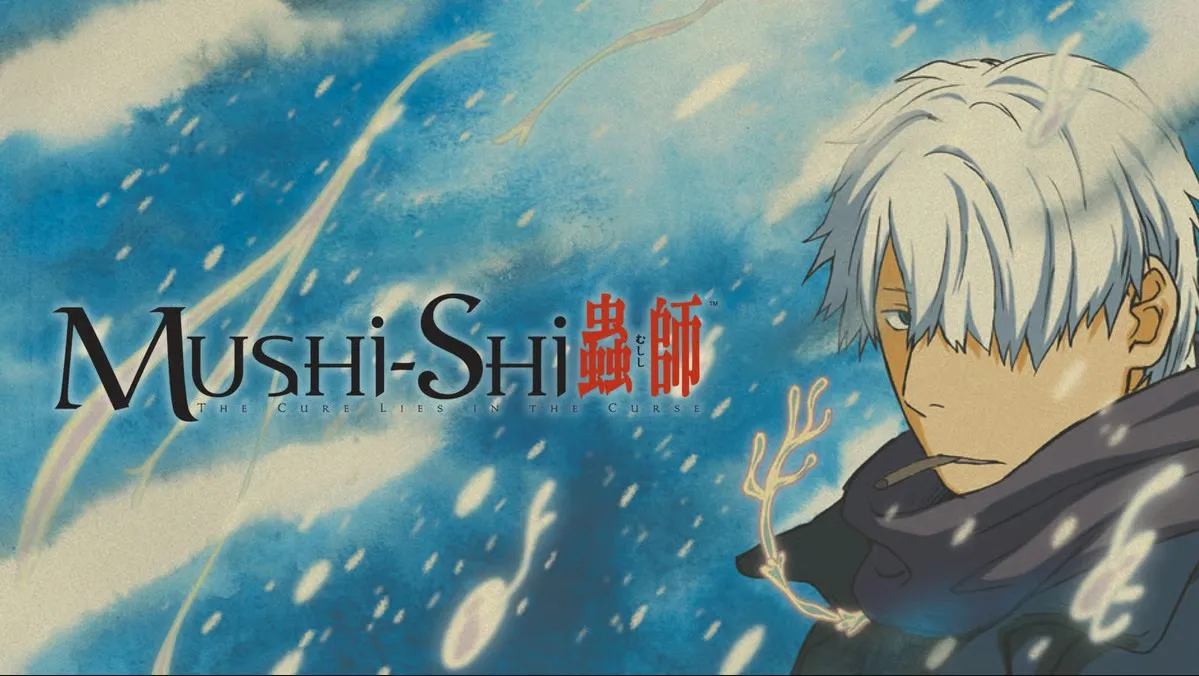

There's an anime where nothing explodes. No one saves the world. The protagonist doesn't power up or defeat a villain. Instead, a white-haired wanderer travels through rural Japan, studying strange life forms that most people can't see, helping villagers understand that they're part of something larger than themselves.
Mushishi is the most naturally pantheist anime I've ever encountered - and it achieves this without ever using the word or preaching any philosophy. It simply shows a world where the boundaries between human and nature dissolve, where life exists in forms we can barely comprehend, and where the appropriate response to existence is quiet wonder.
What Are Mushi?
The series centers on "mushi" - life forms more primitive than bacteria, closer to the essence of life itself. They're not spirits or ghosts in the traditional sense. They're not good or evil. They simply are.
"Mushi: the most basic forms of life in the world. They exist without any goals or purposes aside from simply 'being.' They are beyond the shackles of the words 'good' and 'evil.'"
Mushi can take countless forms - some mimic plants, others cause diseases, some create impossible phenomena like eternal rainbows or living swamps. Most humans can't perceive them at all. But they're everywhere, part of the fabric of existence, influencing human life in ways we rarely notice.
This is remarkably close to how pantheism views the universe. There's no supernatural realm separate from nature - there's just nature, in all its strange and varied forms. The mushi aren't magical beings from another dimension. They're part of this world, part of the same web of existence that includes humans, animals, plants, and everything else.
Ginko: The Wandering Observer
Our guide through this world is Ginko, a "mushishi" - someone who studies mushi and helps people affected by them. He's an unusual protagonist. He doesn't fight. He doesn't have special powers beyond his ability to see mushi. He observes, investigates, and tries to find balance.
Ginko embodies a pantheist approach to existence. He doesn't see mushi as enemies to be destroyed or resources to be exploited. He sees them as fellow inhabitants of the world, following their own nature. When mushi cause problems for humans, it's rarely because they're malevolent - it's because humans have disrupted some balance, or simply because different forms of life have conflicting needs.
His approach is always the same: understand first, then act. What is this mushi? What does it need? How did the situation arise? Often, the "solution" isn't to eliminate the mushi but to restore balance - to find a way for human and mushi to coexist.
This is ecological thinking at its deepest level. Humans aren't the center of the world. We're participants in it, alongside countless other forms of life, each with its own way of being.
Beyond Good and Evil
One of Mushishi's most striking features is its moral neutrality toward nature. The mushi aren't villains. They're not trying to hurt anyone. They're just living according to their nature - the same way a river isn't "evil" when it floods, or a virus isn't "malicious" when it spreads.
This can be unsettling. We're used to stories where problems have clear causes and villains have clear motives. Mushishi refuses this comfort. Sometimes terrible things happen not because anyone chose them, but because that's how existence works.
A mushi might cause a child to lose their hearing. Another might trap someone in an endless dream. These aren't punishments or attacks - they're just what happens when certain life forms interact. The universe isn't arranged for human convenience.
For pantheists, this resonates deeply. We don't believe in a personal God who arranges events for human benefit. The universe is what it is. It contains beauty and horror, creation and destruction, joy and suffering - not because someone planned it that way, but because that's the nature of existence.
Accepting this isn't nihilism. It's realism. And from that realism can come a different kind of peace - not the peace of believing everything happens for a reason, but the peace of accepting reality as it is.
The Light Stream
Mushishi introduces a concept called the "light stream" or "kouki" - a river of life energy that flows through the world, from which all mushi (and perhaps all life) originate. It's depicted as a glowing underground river, beautiful and dangerous, the source of everything.
This is as close as the anime gets to explicit metaphysics, and it's strikingly pantheist. There's no creator deity, no heaven or hell - just this flowing energy that manifests as all the forms of life we see. Everything comes from the same source and returns to it.
Ginko himself was transformed by contact with the light stream as a child - it's why his hair is white and why he can see mushi. He's been touched by the source of life itself, and it changed him permanently.
Ginko's Origin: Touched by the Source
Ginko's backstory, revealed gradually across the series, is itself a pantheist parable. As a young boy named Yoki, he was saved by a mushishi named Nui who lived at the edge of a pool of Tokoyami - eternal darkness, the void from which mushi emerge.
Nui had lost her ability to leave - the darkness had claimed her. She lived in isolation, caring for Yoki, knowing she would eventually be consumed entirely. When the Tokoyami finally took her, young Yoki tried to follow her into the darkness. He survived, but was transformed - his hair turned white, one eye became the green of mushi, and he lost all memory of his former self. He emerged as Ginko.
This origin story resonates with pantheist themes. Ginko literally touched the source of existence - the boundary between being and non-being - and was changed forever. He can never stay in one place too long because mushi are drawn to him; he must keep moving, a permanent wanderer between the human world and the world of mushi.
His transformation wasn't a punishment or a gift. It simply happened - the consequence of contact with something vast and indifferent. And rather than rage against it, Ginko accepted his new nature and found a way to live meaningfully within it.
The light stream suggests that beneath all the apparent diversity of existence, there's a fundamental unity. Different forms of life are different expressions of the same underlying reality. This is core pantheist thinking - the universe is one thing, manifesting in countless ways.
Tokoyami: The Eternal Darkness
Beyond the light stream lies something even more fundamental - the Tokoyami, eternal darkness. It's the void from which mushi first emerge, the boundary between existence and non-existence. Those who enter it rarely return.
The Tokoyami isn't evil. It's not trying to consume anyone. It's simply the absence that defines presence, the darkness that makes light meaningful. In pantheist terms, it's a reminder that existence itself is remarkable - that there could be nothing, and yet there's something.
Mushishi doesn't explain what the Tokoyami ultimately is. It remains mysterious, glimpsed only at the edges of certain episodes. But its presence suggests that the anime takes seriously the deepest questions - not just "how does life work?" but "why is there life at all?"
Humans as Part of Nature
In most stories, humans are special. We're the protagonists of existence, the ones who matter, the measure of all things. Nature exists as our backdrop, our resource, our enemy, or our inspiration - but always in relation to us.
Mushishi quietly rejects this. Humans are just another form of life, no more or less important than mushi, plants, or animals. We have our way of being; other creatures have theirs. Sometimes our ways conflict. Sometimes they harmonize. But there's no cosmic hierarchy placing us at the top.
This is evident in how the show treats human suffering. When someone is afflicted by mushi, the show doesn't frame it as an injustice that must be corrected. It's simply what happened. Ginko helps when he can, but he doesn't rage against the unfairness of it. He accepts that existence includes suffering, and he does what he can within that reality.
For pantheists, this perspective is liberating. We're not fallen beings in a corrupted world, waiting for salvation. We're not the chosen species with dominion over creation. We're part of nature - remarkable, conscious, capable of wonder, but not separate from the web of existence.
The Episodic Structure
Mushishi is almost entirely episodic. Each episode tells a complete story - Ginko arrives somewhere, encounters a mushi-related situation, investigates, and either resolves it or doesn't. Then he moves on.
This structure reinforces the show's philosophy. There's no grand narrative, no ultimate goal, no final victory. Life just continues, one situation after another, each complete in itself. Ginko doesn't accumulate power or progress toward some destination. He simply lives, helping where he can, observing, learning.
This is how pantheists often understand existence. There's no cosmic plot building toward a climax. There's just the ongoing flow of reality, moment after moment, each one complete. Meaning isn't found in reaching some endpoint - it's found in engaging fully with what's here now.
Episodes That Embody Pantheism
A few specific episodes illustrate Mushishi's pantheist vision particularly well:
"The Sound of Rust" (Un)
A girl named Maho attracts a mushi called "Un" that devours sound. Wherever she goes, silence spreads - birds stop singing, streams go quiet, eventually even human voices fade. The villagers see her as cursed.
Ginko discovers that Maho herself isn't the problem - she was born during a moment of absolute silence, and the Un bonded with her. The mushi isn't malevolent; it's simply drawn to the silence it needs to survive. The "solution" isn't to destroy the Un but to find a balance - Maho learns to live with periods of silence, and the village learns to accept her difference.
The episode suggests that what we call "curses" are often just different ways of being that don't fit our expectations. Maho isn't broken. She's just connected to existence differently than others.
"Raindrops and Rainbows"
A rainbow appears over a village and never fades. At first it seems beautiful - a permanent wonder in the sky. But Ginko recognizes it as a mushi called Kourou, and he knows what's coming. The rainbow is feeding on the area's moisture. Eventually, drought will follow.
A young boy in the village loves the rainbow and doesn't want it to go. His father, a mushishi, faces an impossible choice - destroy something beautiful to prevent future harm, or let nature take its course.
The episode refuses easy answers. Beauty and danger aren't opposites - they're often the same thing, seen from different angles. The universe doesn't arrange itself for our convenience.
"The Sea of Brushes"
A calligrapher discovers ink that writes by itself - a mushi that takes the form of living ink, creating characters on paper without human guidance. At first it seems like a gift. But the ink has its own agenda, writing things the calligrapher never intended.
The episode explores the boundary between creation and creator. Who is really writing - the human or the mushi? And does it matter? The characters that emerge are beautiful regardless of their source.
For pantheists, this resonates with questions about consciousness and agency. Are we really the authors of our thoughts, or are we channels for something larger? Mushishi doesn't answer, but it makes the question feel important.
Quiet Wonder
Perhaps Mushishi's most distinctive quality is its tone. It's quiet. Contemplative. Unhurried. The soundtrack is sparse, often just ambient sounds of nature. The pacing is slow by anime standards. There's space to breathe, to observe, to feel.
This creates something rare in media: genuine wonder. Not the manufactured excitement of action sequences or plot twists, but the quiet amazement of really seeing something strange and beautiful. A mushi that creates a sea of grass. A sound that only exists in silence. A rainbow that never fades.
Pantheism, at its heart, is about this kind of wonder. When you really see the universe - not as a backdrop for human drama, but as the astonishing thing it actually is - wonder is the natural response. Mushishi cultivates this seeing.
No Answers, Only Questions
Mushishi doesn't explain everything. We never learn exactly what mushi are, where they come from, or why they exist. The light stream remains mysterious. Many episodes end ambiguously, with situations unresolved or characters changed in ways we can't fully understand.
This is honest. Reality doesn't come with explanations. Science can describe how things work, but the fundamental questions - why is there something rather than nothing? what is consciousness? why does existence exist? - remain open.
Pantheism embraces this mystery. We don't claim to have all the answers. We simply recognize that existence is sacred, that we're part of it, and that wonder is the appropriate response to what we don't understand.
Lessons for Living
Watching Mushishi, certain principles emerge - not as explicit teachings, but as natural conclusions from the world it presents:
- Observe before acting - Understand the situation fully before trying to change it
- Respect other forms of life - They have their own ways of being, as valid as ours
- Accept what you can't change - Not everything can be fixed, and that's okay
- Find wonder in the ordinary - The world is stranger and more beautiful than we usually notice
- Keep moving - Life is a journey, not a destination
- Help where you can - Not to save the world, but because helping is good
These aren't commandments. They're just what emerges from taking the world seriously as it is, rather than as we wish it were.
Japanese Animism and Shinto Roots
Mushishi draws deeply from Japanese spiritual traditions, particularly Shinto animism - the belief that spirits (kami) inhabit all things. Mountains, rivers, trees, rocks - everything has its own spirit, its own way of being.
But Mushishi isn't simply illustrating Shinto beliefs. It's doing something more subtle - taking the animist intuition seriously while stripping away the religious framework. The mushi aren't gods to be worshipped or spirits to be appeased. They're just life, in forms we don't usually perceive.
This makes Mushishi accessible to viewers who don't share Japanese religious traditions. You don't need to believe in kami to feel the truth of what the anime shows - that the world is alive in ways we usually ignore, that we're surrounded by processes and presences we don't understand.
Creator Yuki Urushibara has said she wanted to capture the feeling of the Japanese countryside - the sense that nature is alive and aware, that humans are guests in a world much older than themselves. This is animism as experience rather than doctrine, which is very close to how pantheism works.
Recurring Characters: Different Relationships with Mushi
While Mushishi is mostly episodic, a few recurring characters show different ways of relating to the mushi world:
Adashino is a doctor who collects mushi-related artifacts - objects transformed or created by mushi contact. He's a scientist at heart, curious about mushi but approaching them as specimens to study rather than beings to understand. He represents the limits of purely intellectual engagement with nature.
Tanyuu is a scribe from a family that seals dangerous mushi by writing their stories. The mushi are literally inscribed into her body - her leg is covered in black marks, each one a sealed entity. She bears the weight of containing what cannot be destroyed, a living archive of dangerous knowledge.
Tanyuu's role is fascinating from a pantheist perspective. She doesn't kill the mushi - she transforms them into stories. Narrative becomes a way of integrating what's dangerous into human understanding. The mushi don't disappear; they become part of our meaning-making.
Why This Matters
In an age of climate crisis, ecological collapse, and human alienation from nature, Mushishi offers something valuable: a vision of humans as part of the natural world rather than separate from it.
Most environmental messaging frames nature as something we need to "save" - implying that we're outside it, looking in. Mushishi suggests something different: we're already inside. We're already part of the web. The question isn't whether to connect with nature - we're already connected. The question is whether we'll recognize that connection and act accordingly.
Pantheism makes the same point. You don't need to "find" your connection to the universe - you ARE the universe, temporarily organized into the pattern called "you." The atoms in your body were forged in stars. The water in your cells has been cycling through Earth for billions of years. You're not separate from nature. You're nature, aware of itself.
A Final Image
There's an episode where Ginko encounters a mushi that exists as pure sound - a tone that resonates through a mountain valley, audible only in complete silence. The villagers have learned to live with it, incorporating the silence into their daily rhythms.
It's a perfect image for what Mushishi offers: something that can only be perceived when we stop making noise. The sacred isn't loud or dramatic. It's quiet, pervasive, always present - if we learn to listen.
That's pantheism too. The universe isn't hiding. It's right here, in every breath, every leaf, every moment. We just have to stop, observe, and let ourselves see what's always been there.
Watch Mushishi when you need quiet. When the world feels too loud and too fast. It's available on various streaming platforms, and it rewards patience.
If you find yourself moved by its vision of humans as part of nature, by its acceptance of mystery, by its quiet wonder at existence - you're experiencing something very close to pantheism.