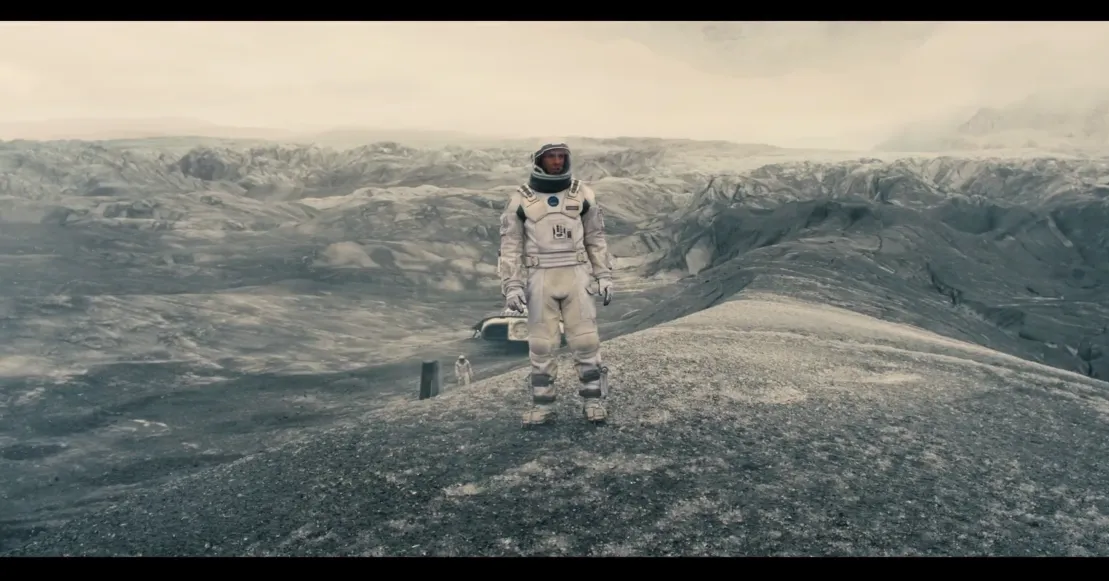

A dying Earth. A desperate mission through a wormhole. A father separated from his daughter by the vastness of space and the dilation of time. Christopher Nolan's Interstellar is a space epic that asks the biggest questions - and arrives at an answer that resonates deeply with pantheism.
The film suggests that love isn't just an emotion. It's a force - as real as gravity, capable of transcending time and space, woven into the fabric of reality itself. This isn't supernatural mysticism. It's something stranger and more beautiful: the recognition that connection is fundamental to the universe.
Note: This article discusses the film's ending and major plot points.
The Setup: A Dying World
Earth is failing. Blight is destroying crops. Dust storms choke the air. Humanity has given up on the stars, focusing only on survival. "We used to look up at the sky and wonder at our place in the stars," Cooper (Matthew McConaughey) says. "Now we just look down and worry about our place in the dirt."
Cooper is a former NASA pilot, now a farmer, raising his children in a world that has abandoned dreams of exploration. His daughter Murphy believes a ghost is communicating with her through falling books and patterns in dust. Cooper dismisses it - until the patterns lead him to a secret NASA facility.
There, he learns that a wormhole has appeared near Saturn - a doorway to another galaxy, possibly placed there by unknown beings. Humanity's only hope is to find a new home among the stars. And Cooper is asked to pilot the mission.
The Sacrifice
To save humanity, Cooper must leave his children - possibly forever. The mission will take years, and due to relativistic time dilation near massive objects, those years will pass differently for him than for those on Earth.
This is the film's emotional core: a father's love for his daughter, stretched across impossible distances and incompatible timeframes. Murphy begs him not to go. Cooper promises to return. Neither knows if that promise can be kept.
The separation is devastating because it's real. Not metaphorical, not reversible - real. Time will pass. Murphy will grow up. Cooper will miss it. And there's nothing either of them can do.
For pantheists, this resonates. We don't believe in an afterlife where separations are healed. Death is real. Loss is real. The time we have with people is finite and precious. Interstellar takes this seriously.
Time as the Enemy
The film's most heartbreaking sequence involves time dilation. On a planet near a black hole, one hour equals seven years on Earth. A brief landing goes wrong, and when Cooper returns to the ship, twenty-three years have passed back home.
He watches decades of video messages from his children. His son grows up, gets married, has children, gives up on him. His daughter becomes a scientist, still angry, still waiting. Cooper weeps as years flash by in minutes.
This is what the universe actually does. Time isn't constant - it bends with gravity and velocity. Einstein showed us this. Interstellar makes us feel it.
The scene is devastating because it shows the cost of cosmic exploration in human terms. The universe is vast and strange, and engaging with it means accepting that our human-scale lives don't fit neatly into its physics.
Dr. Brand's Speech
The film's most controversial moment comes when Dr. Amelia Brand (Anne Hathaway) argues for following her heart to find her lost love, rather than the more logical choice:
"Love isn't something we invented. It's observable, powerful. It has to mean something... Maybe it's some evidence, some artifact of a higher dimension that we can't consciously perceive. I'm drawn across the universe to someone I haven't seen in a decade who I know is probably dead. Love is the one thing we're capable of perceiving that transcends dimensions of time and space."
Many viewers found this speech sentimental or unscientific. But the film ultimately validates it - not as mysticism, but as insight into the nature of reality.
Brand isn't saying love is magic. She's saying it's real - as real as gravity, as fundamental to existence. And the film's ending suggests she's right.
The Tesseract
In the climax, Cooper falls into the black hole Gargantua and finds himself in a tesseract - a three-dimensional representation of time, constructed around Murphy's childhood bedroom. He can see every moment of her life, all at once.
He realizes the truth: the "ghost" that communicated with young Murphy was him, reaching back through time. The beings who placed the wormhole weren't aliens - they were future humans, evolved to exist in higher dimensions, reaching back to save their ancestors.
And the force that allowed Cooper to reach Murphy across time and space? Love. His connection to his daughter was the constant that let him find her across dimensions.
"They didn't bring us here to change the past. They brought us here to save humanity. And they chose me because of my connection to Murphy. Love is the one thing that transcends time and space."
What This Means
Interstellar isn't saying love is supernatural. It's saying something more interesting: that connection is built into the structure of reality.
The future humans who created the tesseract didn't do it randomly. They did it because Cooper's love for Murphy was strong enough to serve as a beacon across dimensions. Love wasn't magic - it was the variable that made the equation work.
This is surprisingly close to pantheist thinking. Pantheism doesn't believe in a personal God who intervenes in human affairs. But it does recognize that connection is real - that we're not isolated individuals bouncing through an indifferent void, but part of a web of relationships that extends through space and time.
The universe, in Interstellar, isn't cold and meaningless. It's structured in ways that allow connection to matter. Love isn't added on top of physics - it's woven into it.
"They" Are Us
One of the film's most profound revelations is that the mysterious beings helping humanity are future humans. "They" aren't aliens or gods - they're us, evolved across millions of years, reaching back to ensure their own existence.
This is a closed loop: future humans save past humans so that future humans can exist to save past humans. It's paradoxical, but it's also beautiful. It means humanity saves itself. Not through divine intervention, but through our own development across cosmic time.
For pantheists, this resonates. We don't wait for salvation from outside. We're part of the universe, and if meaning exists, we create it. If connection matters, we make it matter. The future isn't written by gods - it's written by us.
Rootedness and Transcendence
Interstellar holds two things in tension: the importance of home and the call to transcendence.
Cooper loves his farm, his children, his place on Earth. The film takes this rootedness seriously - it's not something to be escaped but something to be honored. Home matters.
And yet Cooper also feels the pull of the stars. "We're explorers, pioneers - not caretakers," he says. Humanity isn't meant to stay in the dirt forever. We're meant to reach outward, to grow, to become something more.
Pantheism holds this same tension. We're part of nature, rooted in Earth, connected to the web of life here. And we're also part of a universe that extends far beyond Earth - a cosmos that calls us to wonder, to explore, to expand our understanding.
The answer isn't to choose one over the other. It's to honor both - to be rooted and reaching at the same time.
Dylan Thomas and Rage
Throughout the film, characters recite Dylan Thomas's poem "Do not go gentle into that good night." It's a poem about fighting death, refusing to accept extinction quietly.
"Do not go gentle into that good night. Rage, rage against the dying of the light."
This might seem to contradict pantheist acceptance of death. But there's no contradiction. Accepting that death is real doesn't mean giving up. It means engaging fully with life while we have it.
The characters in Interstellar fight to survive not because they deny death, but because life is precious. They rage against extinction because existence matters - not because some god commanded it, but because they choose to value it.
The Ending: Reunion and Continuation
Cooper survives the black hole, rescued by the future humans and returned to a space station orbiting Saturn. Decades have passed. Murphy is now an old woman, surrounded by her children and grandchildren.
Father and daughter reunite - but only briefly. Murphy tells Cooper to go, to find Brand on the new human colony. "No parent should have to watch their child die," she says.
It's bittersweet. They found each other across time and space, but they can't stay together. Life continues. The next generation takes over. Cooper's journey isn't over - it transforms into something new.
This is how pantheism understands existence. Nothing lasts forever. Connections are real but temporary. And that's okay. The point isn't to hold on forever - it's to engage fully while we're here, then let go when it's time.
Science and Spirituality
Interstellar was advised by physicist Kip Thorne, and its depictions of black holes, wormholes, and time dilation are scientifically grounded. The film takes science seriously.
And yet it's also deeply spiritual. It suggests that love matters cosmically, that connection transcends physics, that humanity's future depends on more than just technology.
This combination is what pantheism offers. We don't reject science for spirituality or spirituality for science. We recognize that the universe revealed by science is worthy of reverence - that understanding how things work doesn't diminish wonder but amplifies it.
Interstellar shows a universe that's both scientifically accurate and spiritually meaningful. That's not a contradiction. That's what reality actually is.
Why This Film Matters
In an age of superhero franchises and cynical blockbusters, Interstellar dared to be sincere. It asked big questions and offered genuine answers. It took science seriously and emotion seriously. It suggested that love matters - not as sentiment, but as fundamental truth.
For pantheists, the film offers a vision of cosmic spirituality grounded in reality. The universe is vast and strange. Time bends. Space warps. And through it all, connection persists. Love isn't magic - it's what holds everything together.
Watch Interstellar when you need to feel both small and significant - when you want to be reminded that the universe is vast and that your connections within it are real.
The film doesn't promise easy answers or happy endings. But it does suggest that love transcends - not supernaturally, but naturally. And that's enough.