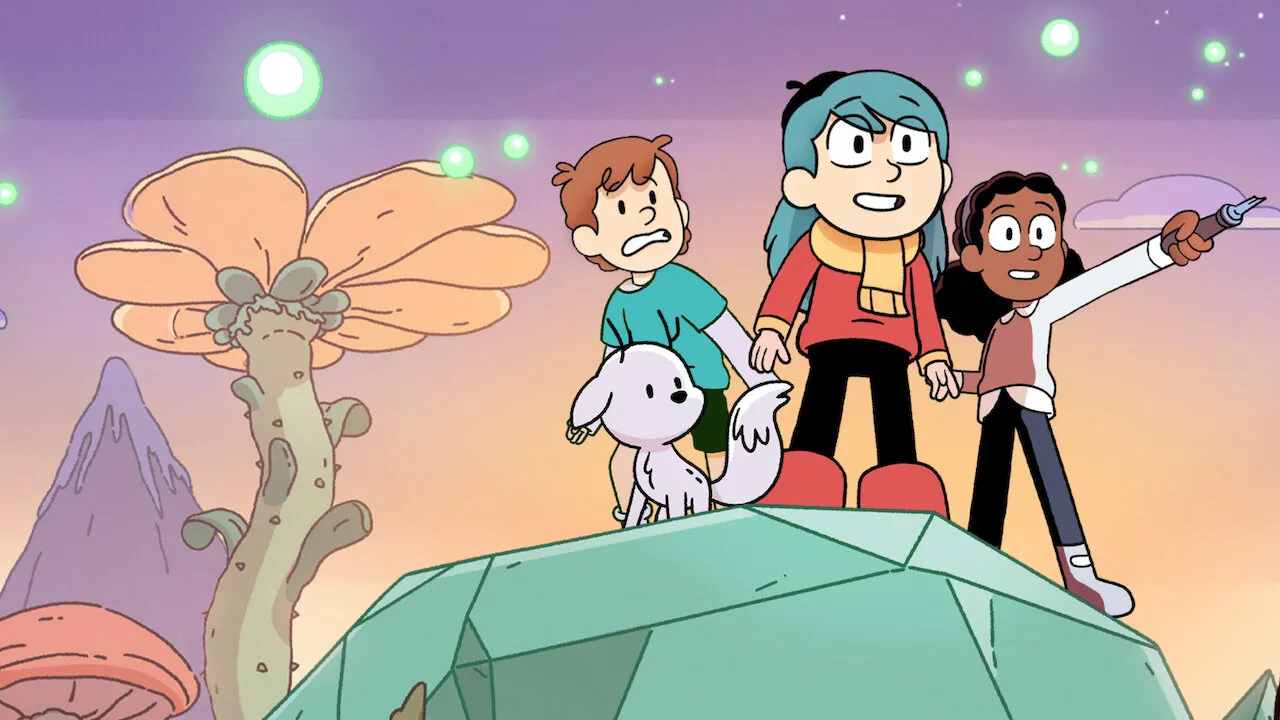
A blue-haired girl befriends trolls. She negotiates treaties with invisible elves. She treats every creature she meets - no matter how strange or dangerous - as worthy of understanding rather than fear. This is Hilda, and it might be the most naturally pantheist show you can watch with your whole family.
Based on Luke Pearson's graphic novels and produced by Netflix, Hilda never mentions pantheism. It doesn't preach anything. But watch a few episodes and you'll notice something: the boundaries between human and nature keep dissolving. Magical creatures aren't invaders or exceptions - they're just part of the ecosystem. And the show treats curiosity and wonder as the only sane responses to existence.
If you've ever felt that nature is alive in ways most people don't notice - that the world is stranger and more sacred than our busy lives allow us to see - Hilda will feel like coming home.
A World Where Magic Is Just Nature
Hilda lives in a Scandinavian-inspired wilderness filled with creatures that most people would call magical - trolls that turn to stone in sunlight, tiny elves who live in invisible houses, giants who sleep for centuries, and spirits that inhabit everything from the weather to the woods.
But here's what makes Hilda different from most fantasy: these creatures aren't supernatural. They're not from another dimension or powered by mystical forces. They're simply part of nature. The trolls have always been there. The elves have their own society. The Wood Man tends his forest. They're as natural as deer or birds - just less commonly seen by humans who've stopped paying attention.
Sound familiar? Pantheism sees the world the same way. No separate supernatural realm. Just nature - vast, strange, full of things we don't understand, but all part of the same interconnected whole. The "magic" in Hilda isn't really magic. It's the parts of nature that most people have forgotten how to see.
Hilda: A Pantheist Protagonist
Hilda embodies pantheist values without ever articulating them. She approaches every creature with curiosity rather than fear. When she meets a troll, she wants to understand it. When she discovers elves, she tries to see the world from their perspective. When she encounters something dangerous, her first instinct is to learn rather than destroy.
She doesn't see humans as the center of the world. In fact, she often finds human society confusing and limiting compared to the rich ecosystem of creatures she grew up with. When her mother moves them to the city of Trolberg, Hilda struggles - not because the city lacks magic, but because most city people have forgotten how to see it.
"I've always thought the world was full of amazing things. I just didn't know how amazing until I started really looking."
Humans aren't special in Hilda's world. We're participants in a vast web of existence, alongside countless other beings. Dominion makes no sense here. Curiosity does. Conquest fails. Coexistence works.
The Trolls: Not Monsters, Just Different
Trolls in Hilda aren't villains. They're ancient creatures who turn to stone in sunlight, emerging at night to wander the mountains. Humans fear them - the city of Trolberg is literally surrounded by a massive wall to keep trolls out. But Hilda sees them differently.
In one of the show's most powerful storylines, Hilda discovers that trolls aren't mindless monsters. They have families. They care for their young. They grieve their losses. The conflict between humans and trolls isn't good versus evil - it's two species with different needs, failing to understand each other.
The show doesn't pretend trolls are harmless - they can be dangerous, especially when threatened. But it refuses the easy narrative of monsters that must be destroyed. Instead, it keeps asking: how can different forms of life coexist? What would it take for humans and trolls to share the world?
If you're a pantheist, you've probably asked similar questions. We don't get a special right to dominate nature just because we're human. Other creatures have their own ways of being, their own needs, their own value. The question isn't how to conquer nature but how to live within it.
The Elves: Invisible Neighbors
Hilda's elves are delightfully strange. They're tiny, they live in houses invisible to humans, and they're obsessed with paperwork and bureaucracy. Step on an elf house - even accidentally, even if you couldn't see it - and you've committed a serious offense requiring formal arbitration.
The elves make a point worth sitting with: the world is full of things we don't perceive. Can't see something? Doesn't mean it isn't there. Don't understand a creature's way of life? Doesn't make it less valid than yours.
Hilda learns to sign elf contracts, to respect elf property, to navigate a world that exists alongside the human world but operates by completely different rules. She doesn't try to make the elves more human. She learns to see the world from their perspective.
Trying to see the world from non-human perspectives, recognizing that our viewpoint is just one among many - that's pantheism in practice. The universe doesn't revolve around our understanding of it.
The Wood Man: Nature With Agency
One of Hilda's recurring characters is the Wood Man - a being made of wood who tends the forest and occasionally wanders into Hilda's life (often uninvited, sometimes inconveniently). He's not quite a tree, not quite a person, but something in between. He has his own concerns, his own way of seeing things, his own slow and patient approach to existence.
He embodies something pantheists feel deeply: nature is alive. Not in a supernatural way, but in the sense that the natural world has its own agency, its own purposes, its own way of being. The forest isn't just a backdrop for human activity. It's a living system with its own interests.
Hilda treats the Wood Man as a friend, even though he's strange and sometimes inconvenient. She doesn't try to make him more human or more useful. She accepts him as he is - a different form of life, worthy of respect on his own terms.
Moving to the City: The Sacred Is Everywhere
When Hilda's mother moves them to Trolberg, Hilda is devastated. She's leaving the wilderness she loves for a city surrounded by walls, where people have forgotten about the magical world. It feels like exile from everything she values.
But the show refuses a simple nature-versus-city narrative. Hilda discovers that the magical world exists in Trolberg too - it's just hidden. There are nisses (house spirits) living in the buildings. Creatures lurk in the parks. The wall keeps trolls out, but it can't keep nature out entirely.
You don't have to live in the wilderness to connect with nature. The sacred is everywhere - in cities, in buildings, in the spaces between. The question is whether you have eyes to see it.
Hilda learns to find wonder in Trolberg, even as she misses the wilderness. She joins the Sparrow Scouts, explores the city's hidden corners, and discovers that her ability to see the magical world is valuable precisely because most city people have lost it.
Coexistence Over Conquest
Throughout the series, Hilda faces conflicts between humans and creatures. The city wants to keep trolls out. The elves want humans to respect their invisible property. Various creatures cause problems for humans, and humans cause problems for creatures.
But Hilda's approach is always the same: understand first, then find a way to coexist. She doesn't try to eliminate the creatures that cause problems. She tries to understand why the conflict exists and whether there's a way for everyone to get what they need.
This isn't naive. The show acknowledges that some conflicts are real and difficult. Trolls can be dangerous. Elves can be unreasonable. Humans can be destructive. But the answer isn't to pick a side and fight. It's to keep trying to understand, to keep looking for solutions that work for everyone.
That's how we should approach our relationship with nature. Not conquest, not exploitation, but ongoing negotiation. How can we live in a way that respects other species? How do we share the world rather than dominate it?
Wonder as a Way of Life
What makes Hilda special isn't just its themes - it's its tone. The show is suffused with wonder. Every episode presents something strange and beautiful. The art is gorgeous, all soft colors and sweeping landscapes. The music is gentle. The pacing is unhurried, letting moments breathe.
Hilda models wonder as a way of life. She's not jaded or cynical. She doesn't take the magical world for granted. Every new creature, every new discovery, fills her with genuine excitement. She's been seeing trolls her whole life, but she still finds them fascinating.
Cultivating wonder. Refusing to let familiarity breed contempt. Staying curious even when you think you understand. The universe is endlessly strange and beautiful. Hilda reminds us to keep noticing.
A Show for All Ages
Hilda is technically a children's show, but like the best children's media, it never talks down to its audience. The themes are sophisticated. The emotions are real. Adults find as much to appreciate as children - perhaps more, since we're the ones who've forgotten how to see.
If you're a pantheist parent, Hilda is a gift. It presents nature connection, respect for all life, wonder at existence - in a form kids absorb naturally. You don't have to explain the philosophy. Just watch together. The worldview seeps in.
For adults without children, Hilda is still worth your time. It's a reminder of what it feels like to see the world with fresh eyes, to approach existence with curiosity rather than cynicism, to believe that understanding is always possible - even when things seem impossibly strange.
Where to Watch
Hilda is available on Netflix, with three seasons and a feature film (Hilda and the Mountain King). The original graphic novels by Luke Pearson are also excellent - the art style is distinctive and the stories have a slightly different tone that's worth experiencing.
If you've never seen it, start with the first episode. You'll know within minutes whether it's for you. And if you're anything like most viewers, you'll find yourself drawn into a world that feels both magical and strangely familiar - a world where nature is alive, where every creature matters, and where wonder is the only appropriate response to existence.
"The world is full of wonderful things you haven't seen yet. Don't ever give up on the chance of seeing them."
- Hilda's mother
Frequently Asked Questions
Is Hilda based on any mythology?
Heavily. Trolls, elves, nisses (house spirits), giants - all from Scandinavian folklore. But the show reimagines them in fresh ways. They feel both ancient and weirdly contemporary.
Is there any religious content in Hilda?
Nothing explicit. No gods, no afterlife talk, no religious practices. Magical creatures just exist as part of nature. Makes it accessible to everyone while quietly embodying pantheist themes.
What age is Hilda appropriate for?
Rated TV-Y7 (ages 7+), though younger kids can watch with parents. Some mildly scary moments - trolls can be intimidating, occasional peril - but nothing too intense. The emotional stuff (change, belonging, loss) is handled well.
Are there other shows like Hilda?
For similar vibes, try Kipo and the Age of Wonderbeasts (post-apocalyptic nature themes), Over the Garden Wall (mysterious forest journey), or Mushishi (more mature, Japanese, deeply pantheist). Studio Ghibli films like My Neighbor Totoro and Princess Mononoke share Hilda's reverence for nature.
Where can I discuss Hilda with others?
There's an active Hilda community on Reddit (r/HildaTheSeries) and various Discord servers. For pantheist discussions specifically, check out our community page or the Pantheism Discord.
Explore More Pantheist Media
Hilda is just one of many films and shows that embody pantheist themes. Our free guide includes a curated list of movies, books, and music that celebrate the sacred in nature.
Get the Free Guide