
Someone asked me recently: "Where does pantheism stand on evolution?" And honestly, I love this question because the answer is so clear: Evolution is one of the most beautiful truths we have. It's literally the story of how the universe creates - not through magic words or divine commands, but through natural processes that are way more elegant than any creation myth ever dreamed up.
The Short Answer: Hell Yes
Look, there's no hedging here. Pantheism fully accepts evolution as scientific fact. Not reluctantly. Not with a bunch of "but what about..." caveats. Not as "just a theory" (which, by the way, misunderstands what "theory" means in science). We embrace evolution as one of the most important things we've ever learned about reality.
For 3.8 billion years, life on Earth has been evolving through natural selection. Single cells became complex organisms. Fish crawled onto land. Reptiles took to the skies. Apes started walking upright. This isn't speculation or guesswork - it's backed by mountains of evidence from genetics, fossils, comparative anatomy, and pretty much every branch of biology.
And here's the thing: for pantheists, this is wonderful. Evolution shows us that the universe doesn't need a cosmic designer to create complexity, beauty, and consciousness. It does this on its own, through processes we can actually understand and observe. How is that not amazing?
Why This Matters So Much
1. We're Part of Nature, Not Above It
Evolution completely destroys the idea that humans are somehow separate from nature - like we were specially created and divinely appointed to rule over everything else. Nope. We evolved from apes. We are apes. Specifically, we're great apes, sharing a common ancestor with chimpanzees about 6-7 million years ago.
And you know what? This isn't diminishing at all. It's humbling in the best possible way. We're not fallen angels stuck in animal bodies. We're animals who became conscious - the universe literally waking up to itself. Tell me that's not more profound than "God made us special on day six."
2. Common Ancestry Means We're Literally All Family
Every living thing on Earth shares common ancestors. You're actually related to the tree outside your window. To the bacteria in your gut. To whales, to mushrooms, to the moss growing on your roof. All of it.
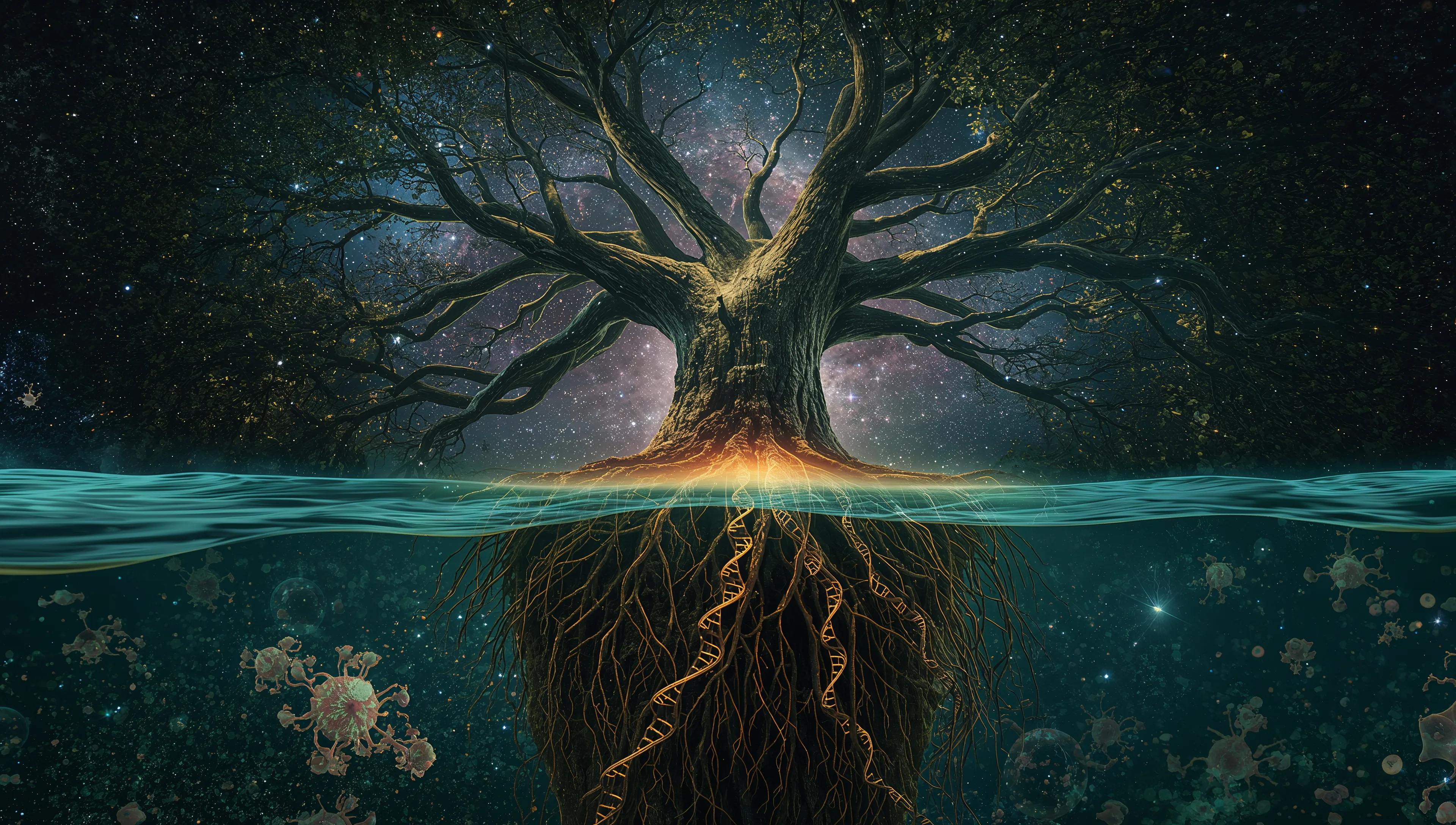
Go back far enough, and we all descend from the same single-celled organisms floating around in Earth's ancient oceans. The tree of life isn't a cute metaphor - it's a literal family tree, and you're on it.
For pantheists, this kinship is sacred. When we say "everything is connected," we're not being mystical or woo-woo. We're stating biological fact. Your DNA uses the same genetic code as every other living thing on this planet. You share about 60% of your genes with a banana. You share 98.8% with a chimpanzee. We're family.
3. Evolution Is Creative, Not Random Chaos
Here's a common misunderstanding: "Evolution is random, therefore life is meaningless." But this completely misses how evolution actually works.
Yes, mutations are random. But natural selection is not random at all. It's a filter - a process that keeps what works and discards what doesn't. Over enormous stretches of time, this creates incredible adaptations: eyes that can see, wings that can fly, brains that can contemplate the universe.
Think of natural selection as the universe's way of exploring possibilities. It's creative - not in the sense of having some grand plan, but in the sense of generating endless novelty and complexity. The universe doesn't need to be conscious to be creative. The process itself is remarkable enough.
Let's Talk About Deep Time
One of the wildest things about evolution? The timescales. We're talking about spans of time that are almost impossible to wrap your head around.
The Timeline of Life on Earth
- 3.8 billion years ago: First life emerges - simple single-celled organisms
- 3 billion years: Life remains single-celled, slowly transforming the planet
- 2.4 billion years ago: Photosynthesis evolves, oxygen accumulates in atmosphere
- 1.5 billion years ago: First complex cells with nuclei (eukaryotes)
- 540 million years ago: Cambrian explosion - sudden diversification of complex life
- 375 million years ago: First animals walk on land
- 230 million years ago: Dinosaurs emerge
- 66 million years ago: Asteroid wipes out dinosaurs, mammals inherit Earth
- 6-7 million years ago: Human lineage splits from chimpanzees
- 300,000 years ago: Homo sapiens emerges in Africa
- 10,000 years ago: Agriculture begins
- Right now: You, reading this, contemplating your own origin
For most of Earth's history, there was no consciousness. No one around to witness any of it. Just physics and chemistry doing their thing across billions of years. Then, somehow, matter organized itself in such a way that it became aware.
You are the universe, conscious. Think about that. Your existence required 3.8 billion years of evolution, 4.5 billion years of planetary formation, and 13.8 billion years of cosmic history. Every single ancestor in your lineage - going all the way back to the first replicating molecules - had to survive long enough to reproduce. You're the product of an unbroken chain of survival stretching back to the beginning of life itself.
How Natural Selection Actually Works
Here's the beautiful part: evolution by natural selection is elegantly simple. It only requires three things:
- 1
Variation
Organisms in a population differ from each other (due to genetic mutations, sexual reproduction, etc.)
- 2
Inheritance
Offspring inherit traits from their parents (through DNA)
- 3
Selection
Some variants survive and reproduce better than others in their environment
That's it. Give these three conditions enough time, and you get evolution. Complex adaptations emerge not because someone designed them, but because they were selected - preserved and refined over countless generations.
A giraffe's neck didn't get long because giraffes stretched to reach high leaves (sorry, Lamarck). It got long because giraffes with slightly longer necks had a survival advantage, reproduced more, and passed on their genes. Over millions of years, this gradual process produced the remarkable creatures we see today.
The Evidence Is Overwhelming
Let's be clear: evolution isn't "just a theory" in the way people use that phrase casually. In science, a theory is an explanation supported by massive amounts of evidence. Evolution is as well-established as gravity or germ theory. We're not guessing here.
Fossil Record
We have transitional fossils showing the gradual change from fish to amphibians, from reptiles to mammals, from land mammals back to whales. We can literally watch evolution happen in the rocks.
Comparative Anatomy
Your arm, a whale's flipper, a bat's wing, and a horse's front leg all have the same bone structure. Why? Because we all inherited it from a common ancestor. Evolution predicts this. Separate creation? Doesn't explain it at all.
DNA Evidence
We can now read the genetic code and see the family relationships directly. Humans and chimps share 98.8% of their DNA. We even share the same genetic "typos" - broken genes, viral insertions - in exactly the same places. This only makes sense if we share common ancestors.
Observed Evolution
We've literally watched evolution happen in real-time: bacteria developing antibiotic resistance, viruses adapting to new hosts, populations of organisms changing in response to environmental pressures. Evolution isn't just something that happened in the past - it's happening right now.
But What About Meaning and Purpose?
Here's where pantheism splits from both creationism and cold materialism.
Creationists say: "If we weren't designed, life has no meaning." Some materialists agree: "We're just accidents, so nothing matters."
Pantheists? We reject both of these conclusions.
Yes, we evolved. Yes, there was no predetermined plan. Yes, if conditions had been slightly different, we wouldn't exist. But so what?
Meaning doesn't require a designer. Meaning emerges naturally when conscious beings exist. You care about things. You love people. You find beauty in sunsets and music and ideas. These feelings are real - they're patterns of neurons firing, sure, but that doesn't make them less real or less valuable.
The universe didn't need to create you for some predetermined purpose. You get to create your own purpose. And that's not a bug - it's a feature. It's freedom.
Consciousness Evolved Too
Here's maybe the most mind-blowing fact: consciousness itself evolved.
For billions of years, the universe existed without knowing it existed. Then, through natural selection, nervous systems got more complex. Simple reflexes became sophisticated brains. Somewhere along the way - we don't know exactly when or how - subjective experience emerged.
You are matter that has become aware of itself. The atoms in your brain, forged in ancient stars, organized through billions of years of evolution, are now contemplating their own existence.
This is what pantheists mean when we say "the universe waking up." We're not being metaphorical. We mean it literally. You are the cosmos, conscious.
Why We Reject Intelligent Design
Intelligent Design (ID) claims that some biological features are "too complex" to have evolved naturally and must have been designed. Here's why pantheists reject this:
- ✦ It's a God-of-the-gaps argument: "We don't understand this yet, therefore God did it." But science keeps filling those gaps. Every "irreducibly complex" system ID has proposed has been explained by evolution.
- ✦ Natural selection explains complexity: Small incremental changes, preserved by selection, create remarkable adaptations over time. No designer needed.
- ✦ Imperfection is everywhere: Vestigial organs, bad design, jury-rigged solutions. Your eye has a blind spot because the retina is wired backwards. Evolution predicts this. Intelligent design? Not so much.
- ✦ It's not actually science: ID makes no testable predictions, explains nothing, and can't be falsified. It's just creationism wearing a lab coat.
The universe doesn't need a designer to create complexity. It creates complexity naturally, through processes we can actually observe and understand. That's more elegant - and honestly, more sacred - than any design argument.
Extinction and Renewal
Evolution isn't just about creation - it's also about destruction. Over 99% of all species that have ever lived are now extinct.
This can seem harsh. But it's part of the process. Extinction makes room for new forms. That asteroid that killed the dinosaurs? It allowed mammals to flourish. Without that catastrophe, we wouldn't be here.
For pantheists, this is just the rhythm of the universe. Creation and destruction. Birth and death. The cosmos doesn't preserve every form - it experiments, explores, moves on. We're part of that ongoing process, not the endpoint.
What This Means for How We Live
Understanding evolution changes how we relate to other life:
We're Not Special (In One Sense)
We're not the pinnacle of creation, placed here to dominate everything else. We're one species among millions, all equally evolved, all equally "successful" at surviving in our particular niches.
We Are Special (In Another Sense)
We're the only species (that we know of) capable of understanding evolution, contemplating the universe, creating art and science and philosophy. Consciousness is rare and precious.
Kinship With All Life
Common ancestry means we're literally related to every living thing. This isn't sentimental fluff - it's genetic fact. And it grounds environmental ethics in reality: harming the biosphere is harming our extended family.
The Wonder Only Increases
Some people think evolution makes life less meaningful. But honestly? The opposite is true.
A flower isn't less beautiful because we understand photosynthesis. A sunset isn't less moving because we know it's light scattering through atmosphere. Understanding how something works doesn't kill the wonder - it deepens it.
When you look at a tree and know that you share ancestors with it, that your cells use the same genetic code, that you're both expressions of the same evolutionary process - the tree becomes more remarkable, not less.
When you hold a baby and realize that every cell in that child's body contains 3.8 billion years of evolutionary history, all encoded in DNA - the miracle isn't diminished. It's magnified.
"Nothing in biology makes sense except in the light of evolution." - Theodosius Dobzhansky, evolutionary biologist
Evolution Is Still Happening
Evolution didn't stop with humans. It's happening right now, all around you. Bacteria are evolving resistance to antibiotics. Viruses are adapting to new hosts. Species are responding to climate change.
You're not a finished product. You're a moment in an ongoing process. Our species will continue to evolve (if we survive long enough). The universe is still creating, still exploring, still becoming.
And you get to witness it. You get to understand it. You get to participate in it - through your choices, your actions, your contribution to the ongoing story of life on Earth.
The Pantheist Position: Summary
Where Pantheism Stands on Evolution
- ✓ Evolution is fact - Supported by overwhelming evidence from multiple scientific fields
- ✓ Evolution is sacred - The universe's creative process, elegant and profound
- ✓ No designer needed - Natural selection creates complexity without consciousness or plan
- ✓ We're part of nature - Evolved apes, not special creation
- ✓ Common ancestry is profound - We're related to all life on Earth
- ✓ Meaning emerges naturally - Not imposed from outside, but created by conscious beings
- ✓ Wonder increases with understanding - Evolution is MORE amazing than creation myths
- ✓ Ethics from kinship - We're family with all organisms, grounding environmental responsibility
Further Exploration
If you want to dive deeper into evolution, here are some accessible starting points:
- Books: The Greatest Show on Earth by Richard Dawkins, Your Inner Fish by Neil Shubin, The Ancestor's Tale by Richard Dawkins
- Documentaries: Cosmos (both Carl Sagan's original and Neil deGrasse Tyson's update), David Attenborough's Life series
- Online: Khan Academy's biology courses, PBS Eons on YouTube, Understanding Evolution from UC Berkeley
Evolution is the universe's greatest story - 3.8 billion years of creativity, experimentation, and emergence. It doesn't diminish the sacred. It reveals it.
You're the product of that story. You're stardust that learned to think, matter that became conscious, the cosmos waking up to itself. No creation myth is more profound than that.