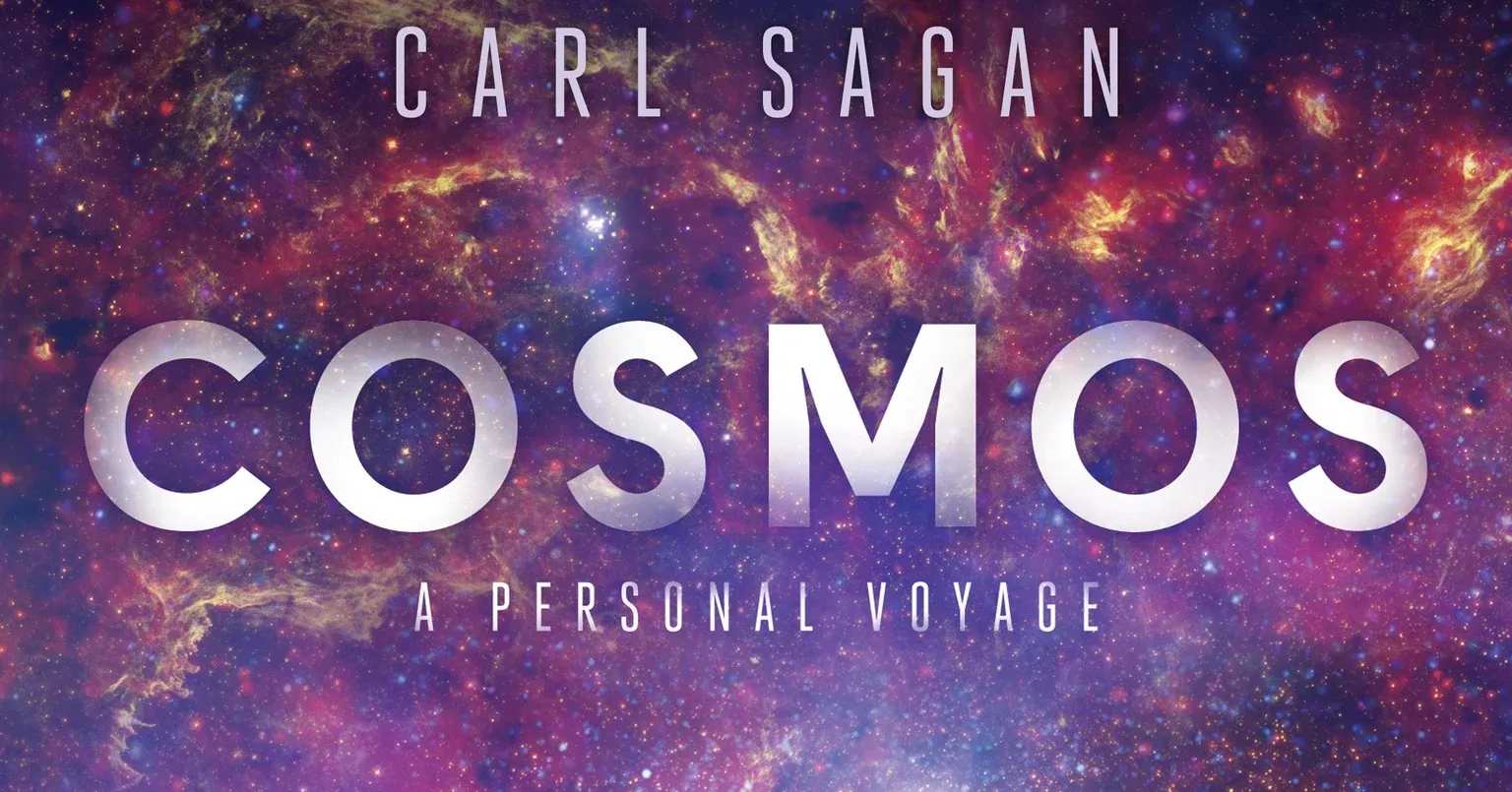

In 1980, a scientist in a turtleneck stood on a cliff and said: "The cosmos is all that is, or ever was, or ever will be." With those words, Carl Sagan began a television series that would change how millions of people understood their place in the universe - and offer something that looked remarkably like pantheism to a mainstream audience.
Cosmos: A Personal Voyage wasn't just science education. It was an invitation to wonder. It treated the universe not as a collection of facts to be memorized, but as something sacred - worthy of awe, reverence, and love.
More Than Science
Plenty of documentaries explain science. Cosmos did something different. It made science feel like a spiritual experience.
Sagan didn't just tell us that stars are balls of hydrogen undergoing nuclear fusion. He told us that we're made of star-stuff - that the atoms in our bodies were forged in the hearts of ancient suns. He didn't just explain evolution. He showed us that we're connected to every living thing on Earth through an unbroken chain of ancestry stretching back billions of years.
The facts were accurate. But the framing was spiritual. Sagan understood that knowledge alone doesn't satisfy the human hunger for meaning. We need to feel our connection to something larger. And he showed that science, properly understood, provides exactly that.
"The nitrogen in our DNA, the calcium in our teeth, the iron in our blood, the carbon in our apple pies were made in the interiors of collapsing stars. We are made of star-stuff."
The Ship of the Imagination
Cosmos used a visual device called the "Ship of the Imagination" - a spacecraft that could travel anywhere in space and time. Sagan would stand on its bridge, gazing out at galaxies, nebulae, the surfaces of distant planets.
The ship was obviously a special effect. But it served a deeper purpose. It invited viewers to imagine themselves traveling through the cosmos - not as distant observers, but as participants. The universe wasn't "out there." We were in it, moving through it, part of it.
This is the pantheist shift in perspective. We're not separate from the universe, looking at it from outside. We're expressions of it, temporary patterns in its ongoing unfolding. The Ship of the Imagination made this visceral.
Sagan's Reverence
Watch any episode of Cosmos and you'll notice something: Sagan speaks about the universe with reverence. Not the reverence of traditional religion - he was skeptical of supernatural claims. But a genuine awe at what exists.
"The beauty of a living thing is not the atoms that go into it, but the way those atoms are put together. Information distilled over four billion years of biological evolution. Incidentally, all the information about nuclear war, it's a much more recent product, and it's not very interesting."
Sagan found the universe beautiful, meaningful, worthy of protection. He didn't need a creator God to feel this way. The universe itself was enough.
This is pantheism's core insight. The sacred isn't somewhere else - in heaven, in scripture, in supernatural realms. The sacred is here, in the natural world, in the cosmos as science reveals it. Sagan showed millions of people what that feels like.
The Cosmic Calendar
One of Cosmos's most famous sequences compressed the 13.8 billion year history of the universe into a single calendar year. The Big Bang happens on January 1st. The Milky Way forms in March. The Sun and Earth appear in September. Life begins shortly after.
And humans? We appear in the last few seconds of December 31st. All of recorded history - every empire, every war, every work of art - happens in the final second before midnight.
This could be depressing. It could make human life seem insignificant. But Sagan didn't present it that way. He presented it as perspective - a way of understanding our place in the cosmic story.
We're recent arrivals. We're small. And yet we're here, conscious, able to understand the story we're part of. That's not insignificance. That's wonder.
The Pale Blue Dot
Years after Cosmos aired, Sagan convinced NASA to turn the Voyager 1 spacecraft around and photograph Earth from 3.7 billion miles away. The result was the famous "Pale Blue Dot" image - Earth as a tiny speck, barely visible against the vastness of space.
Sagan's reflection on this image is essentially a pantheist sermon:
"Look again at that dot. That's here. That's home. That's us. On it everyone you love, everyone you know, everyone you ever heard of, every human being who ever was, lived out their lives... on a mote of dust suspended in a sunbeam."
He continued:
"There is perhaps no better demonstration of the folly of human conceits than this distant image of our tiny world. To me, it underscores our responsibility to deal more kindly with one another, and to preserve and cherish the pale blue dot, the only home we've ever known."
This is cosmic perspective leading to ethical commitment. Because we're small, because we're fragile, because this is all we have - we should treat each other and our planet with care. Not because a god commands it, but because reality demands it.
Science as Spirituality
Sagan was explicit that science could be a source of spiritual experience:
"Science is not only compatible with spirituality; it is a profound source of spirituality. When we recognize our place in an immensity of light-years and in the passage of ages, when we grasp the intricacy, beauty, and subtlety of life, then that soaring feeling, that sense of elation and humility combined, is surely spiritual."
This is what Cosmos offered: spirituality grounded in reality. Not faith in things unseen, but wonder at things seen. Not hope for another world, but reverence for this one.
For pantheists, Sagan articulated what we feel but sometimes struggle to express. The universe IS sacred. Science IS a way of knowing the sacred. Wonder IS the appropriate response to existence.
Cosmos: A Spacetime Odyssey (2014)
In 2014, Neil deGrasse Tyson hosted a sequel series, updating Sagan's vision for a new generation. It maintained the same spirit - science as wonder, the cosmos as sacred, humans as part of something vast.
Tyson added his own perspective, particularly on the history of science and the courage required to pursue truth against established authority. But the core message remained: the universe is amazing, we're part of it, and understanding it is one of the most meaningful things we can do.
The new series reached millions more viewers, continuing Sagan's mission of making cosmic spirituality accessible to everyone.
Why Cosmos Matters
Cosmos matters because it showed that you don't have to choose between science and meaning. You don't have to abandon wonder when you abandon superstition. You don't have to feel small and insignificant just because you're small.
The series offered an alternative to both traditional religion and cold materialism. It said: the universe is enough. What science reveals is more than enough to inspire awe, to ground ethics, to provide meaning. You don't need to add anything supernatural. Reality is already sacred.
This is pantheism, broadcast to hundreds of millions of people. Sagan never used the word - he was careful with labels. But his vision aligns almost perfectly with what pantheists believe.
The Ongoing Mission
Sagan died in 1996, but his influence continues. The Planetary Society he co-founded still advocates for space exploration. His books remain in print. And Cosmos itself keeps finding new audiences.
More importantly, the approach he pioneered - treating science as a source of wonder and meaning - has spread. Science communicators like Neil deGrasse Tyson, Brian Cox, and others carry forward the mission of making the cosmos accessible and meaningful.
For pantheists, this is encouraging. The worldview we hold - that the universe is sacred, that science reveals the sacred, that we're part of something vast and beautiful - is reaching more people than ever. Not through preaching, but through showing. Not through doctrine, but through wonder.
Watching Cosmos Today
The original Cosmos is dated in some ways - the special effects, the fashion, some of the science that's been updated. But the core experience remains powerful.
Watch it when you need perspective. When the news is overwhelming and human affairs seem petty. When you've forgotten that you're made of star-stuff, that you're the universe experiencing itself, that existence is remarkable.
Sagan's voice, calm and wondering, reminds us of what we already know but often forget: we're home. We've always been home. The cosmos isn't somewhere else - it's here, and we're part of it.
"We are a way for the cosmos to know itself."
Watch Cosmos - either version - when you need to remember what's real. When you want to feel connected to something larger than yourself. When you're ready to experience science as spirituality.
The original series is available on various streaming platforms. The 2014 sequel is on Disney+ and Hulu. Both offer something increasingly rare: genuine wonder at the universe we actually live in.